
Total: Rs. 0.00
Taxes and shipping calculated at checkout

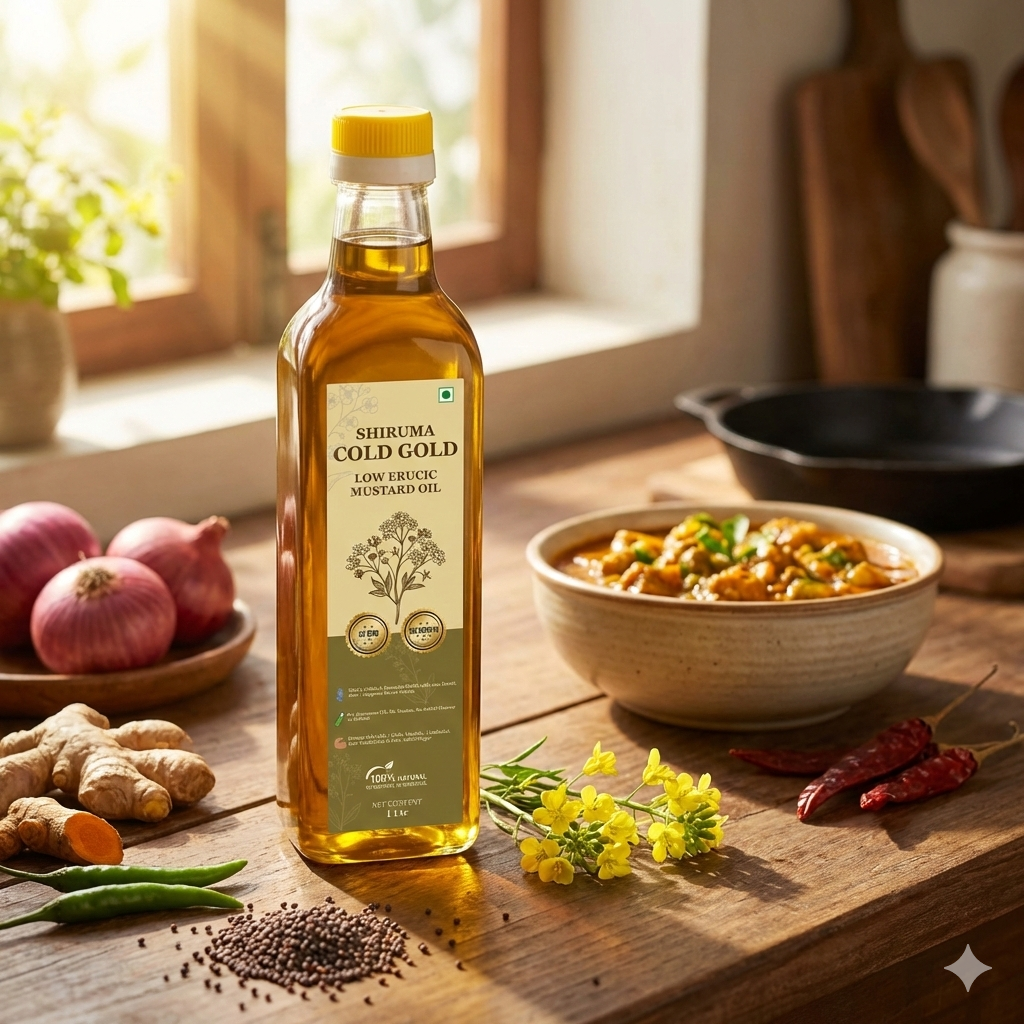
Walk into any Indian kitchen a generation ago and you'd find one bottle doing almost everything — tempering dal, frying pooris, oiling hair before an oil massage, even soothing a cold chest at bedtime. That bottle held cold-pressed mustard oil, or kachi ghani oil, pressed the old way: slowly, without heat, without chemicals.
Somewhere between then and now, refined oils took over the shelf. They're cheaper to produce, have a longer shelf life, and carry almost no smell — which sounds convenient, until you realize that "no smell" often means "no nutrients either." Here's why cold-pressed mustard oil is worth bringing back.
Cold-pressing is a mechanical extraction method where mustard seeds are crushed at low temperatures — typically under 40°C — with no solvents involved. Refined oils, by contrast, are usually extracted using heat and chemical solvents like hexane, then bleached and deodorized to strip away the natural pungency and color.
That heat-and-chemical process is efficient, but it also breaks down heat-sensitive nutrients and strips the oil of the very compounds that make mustard oil valuable in the first place — allyl isothiocyanate (the compound responsible for its sharp aroma), natural antioxidants, and monounsaturated fats.
Cold-pressing keeps all of that intact.
1. A healthier fat profile. Mustard oil naturally has one of the best fatty acid ratios of any cooking oil — low in saturated fat, high in monounsaturated fatty acids (MUFA), and a favorable omega-3 to omega-6 ratio. Several nutrition studies have pointed to this profile as supportive of heart health when used as part of a balanced diet, which is one reason mustard oil has stayed a staple across North and East India for generations.
2. Natural antimicrobial and anti-inflammatory properties. The allyl isothiocyanate compound isn't just responsible for that sharp, pungent smell — it also gives mustard oil natural antibacterial and antifungal properties. This is part of why it has traditionally been used for oil massages and topical application, not just cooking.
3. A high smoke point suited to Indian cooking. Cold-pressed mustard oil has a smoke point of around 250°C, which makes it well suited to the high-heat frying and tempering common in Indian cuisine, without breaking down as quickly as more delicate oils.
4. No chemical residue. Because there's no solvent extraction involved, cold-pressed oil doesn't carry the trace solvent residues that can remain in refined oils even after processing.
5. Nutrients stay where they belong. Vitamin E, natural antioxidants, and plant sterols degrade under high heat. Cold-pressing means they survive the extraction process instead of being processed out for the sake of a longer shelf life.
If you've shopped for mustard oil recently, you may have noticed some brands calling out "low erucic acid" on the label. Erucic acid is a naturally occurring fatty acid in mustard and rapeseed oil. In very high concentrations, some studies have linked it to potential effects on heart tissue in animal models — though the levels involved were far higher than typical dietary exposure in humans.
Regardless, it's a legitimate reason to care about which mustard seed varietal your oil comes from and how it's tested. Reputable producers now select lower-erucic seed varietals and lab-test each batch to keep erucic acid content within safe, regulated limits — rather than leaving it to chance.
This is exactly why lab reports matter for an oil like this: you shouldn't have to take a brand's word for what's in the bottle.
Not everything labeled "cold-pressed" on a shelf actually is. A few things worth checking before you buy:
At Shiruma, our FarmPure and ColdGold mustard oils are pressed the traditional way — slowly, at low temperatures, from seed we source directly through our own farming network with full traceability back to source. Every batch is independently lab tested before it reaches your kitchen, and those reports are available for anyone who wants to see them, not just claimed on a label.
If you've been cooking with refined oil out of habit, it might be worth going back to what your grandmother's kitchen already knew.
Browse our cold-pressed mustard oil collection or check our lab reports for full batch-wise testing transparency.
